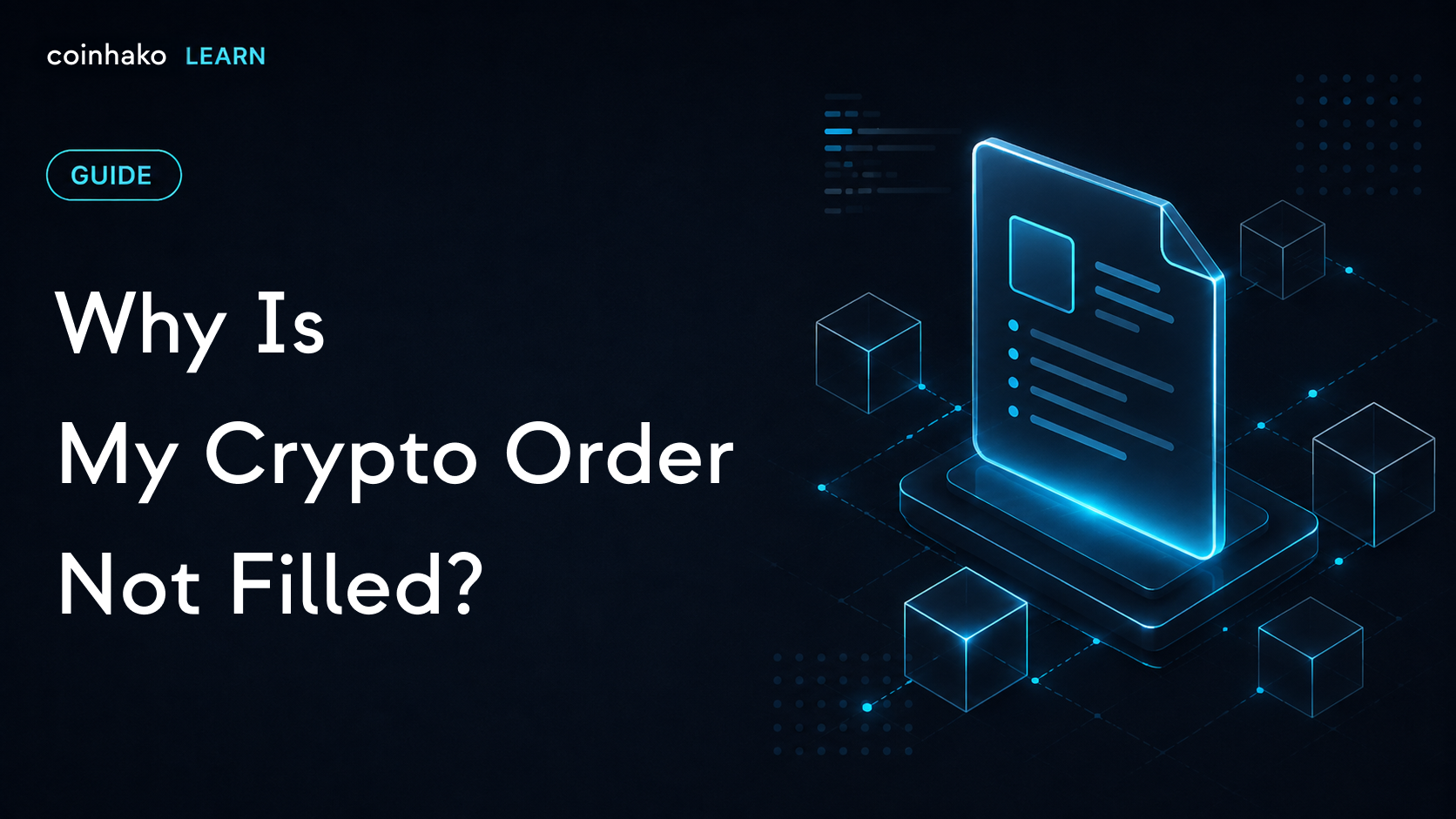
A crypto trading order does not always execute immediately.
This is particularly common with a limit order, where a user specifies the price at which they are willing to buy or sell an asset.
If the required market conditions are not met, the order may remain open or may only be partially filled.
Why is my limit order not filled?
A limit order generally executes only when a matching order is available at the specified price or a more favourable price.
For example, if an asset is trading around S100andabuylimitorderisplacedatS95, the order may remain open unless sellers become available at S$95 or below.
Common reasons an order may remain unfilled
The market has not reached the selected price
If the market price does not reach the limit price, there may be no matching order available.
There is insufficient liquidity
Even when the selected price becomes available, there may not be enough quantity at that price to fill the entire order.
This can result in a partial fill.
Prices moved quickly
In volatile markets, prices may move through a level quickly.
An displayed price does not necessarily mean sufficient quantity was available for every order at that level.
Other orders may have priority
Multiple orders can exist at the same price.
The order in which they are matched depends on the rules of the relevant trading system, which may include factors such as price and time priority.
Market order vs limit order
A market order generally seeks to execute using available market prices.
A limit order specifies the maximum buying price or minimum selling price that the user is prepared to accept.
As a result, limit orders offer greater price control but do not guarantee execution.
Market orders may execute more quickly but may be filled at different prices depending on available liquidity and order size.
Can an order be partially filled?
Yes.
If only part of the required quantity is available at the selected price, part of the order may execute while the remaining amount stays open.
Whether this occurs depends on market liquidity and the order conditions.
Is an unfilled order the same as a failed transaction?
No.
An open or unfilled order generally means that the conditions required for matching have not yet been met.
A failed transaction usually refers to a different technical or processing outcome.
Example
An asset has a lowest available selling price of S$101.
A user places a buy limit order at S$98.
If no seller is willing to sell at S$98 or below, the order remains open.
If suitable sell orders later become available, the order may be matched, subject to available liquidity and order priority.
In summary
A crypto order may remain unfilled because the market has not reached the selected price, available liquidity is insufficient or other orders have priority.
Limit orders allow users to set an acceptable price but do not guarantee that a transaction will occur.
Understanding how order matching, liquidity and market prices work can help users interpret why an order remains open.
Quick Answers
Why is my limit order still open?
The selected price may not have been reached, or there may not be enough matching liquidity.
Can a limit order be partially filled?
Yes. Part of the order may execute while the remaining amount stays open.
Does a limit order guarantee execution?
No. A limit order specifies acceptable pricing conditions but does not guarantee that a matching order will become available.
Tell me more…
- What Is Cryptocurrency?
- What Is Blockchain?
- What Is Bitcoin?
- What Is Ethereum (ETH)?
- What Is a Crypto Exchange?
- What is a Stablecoin in Cryptocurrency?
- What is a Memecoin?
- How Does Crypto Trading Work?
- What Is Slippage in Crypto Trading and Why Does It Matter?
- APY vs APR in Crypto: What's the Difference?
- Crypto Fees Explained: Trading Fees vs Withdrawal Fees vs Network Fees
- What Are Gas Fees?
- What Are Ethereum Gas Fees and Why Do They Change?
- How to Check Ethereum Gas Fees Before Sending a Transaction
- Why Ethereum Transactions Get Stuck and How to Fix Them
- What are Ethereum Layer-2 Blockchains?
- What Is a Crypto Wallet and How Does It Work?
- Hot Wallet vs Cold Wallet: Which Is Safer for Storing Crypto?
- Private Keys vs Public Keys: What’s the Difference in Crypto?
- How to Keep Your Crypto Secure
- Cybersecurity in Singapore: How to Identify Fraudulent Investment Schemes and Protect Your Bitcoin
- Bitcoin Security in Singapore: How to Store and Protect Your Digital Assets Safely
- Crypto Wallet Security in Singapore: How to Safeguard Your Bitcoin and Private Keys
- Buying Bitcoin in Singapore: How to Start Investing in Digital Assets Safely
- Bitcoin Transactions Explained: How to Send and Receive Digital Assets Safely
- Crypto Phishing Attacks in Singapore: How to Identify Fake Websites and Protect Your Digital Assets
- Common Crypto Scams in Singapore and How to Avoid Them
- What Is MEV (Maximal Extractable Value) in Crypto?
- What Is a Smart Contract in Blockchain?
📬 Stay Updated
📩 Sign-up to Subscribe to our mailing list to have them delivered straight to your inbox!
👉 Follow our X.
🤝 Need Help?
🤔 If you have any enquiries, you may contact us here or you can visit our Information Page.
🌏 Coinhako is available in these countries!
🚀 Buy Bitcoin at Coinhako Singapore
Copyright © Coinhako 2026 All Rights Reserved. Read more on our terms of use of this blog.
All opinions expressed here by Coinhako.com are intended for educational purposes, taken from the research and experiences of the writers of the platform, and should not be taken as investment or financial advice.